Nifty Monthly Expiry Today: Ambuja Cements, Kaynes Technology and SAIL Enter the F&O Ban List
Quick Summary
- Nifty 50 ended the 26 October 2026 session at 22,753.20, up 153.20 points (0.68%).
- Sensex closed at 73,606.75, higher by 482.92 points (0.66%).
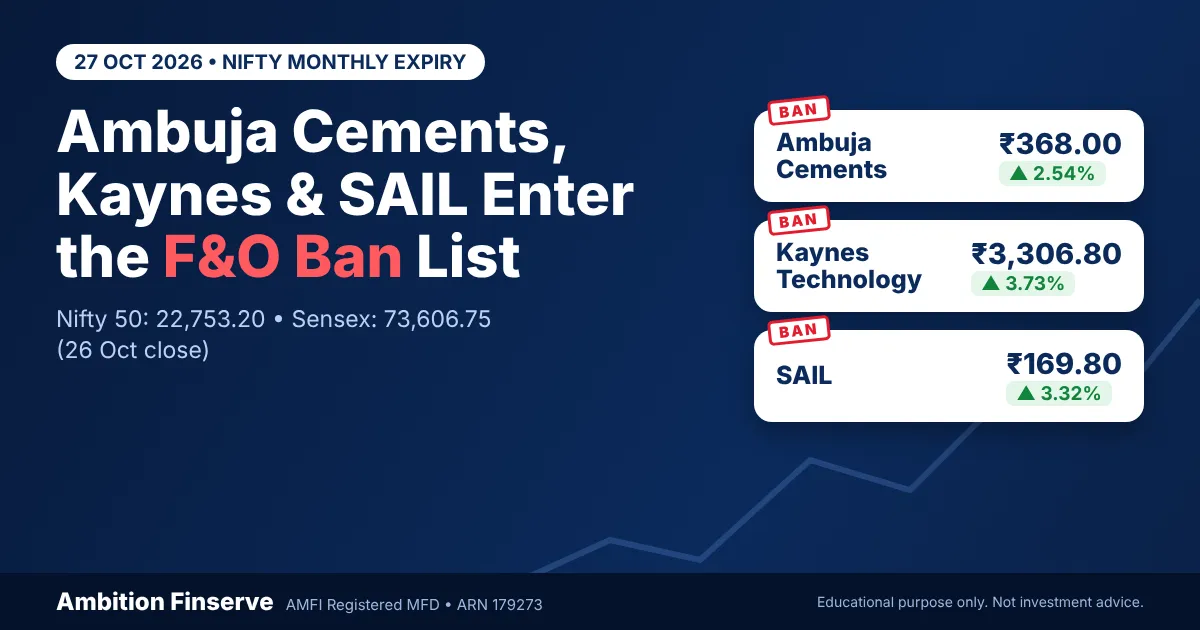
- NSE has put Ambuja Cements, Kaynes Technology and SAIL in the F&O ban for the Nifty monthly expiry on 27 October 2026.
- Fresh derivative positions are blocked in these stocks, but cash market trading continues as usual.
Market Snapshot Before Expiry
Indian equities finished the previous session on a firm note. The Nifty 50 added 153.20 points, or 0.68%, to settle at 22,753.20, while the BSE Sensex rose 482.92 points, or 0.66%, to end at 73,606.75. With the monthly expiry arriving the very next day, participants are watching how open positions get rolled over or closed, since expiry sessions often bring sharper intraday moves.
Stocks in the F&O Ban on 27 October 2026
Ahead of the expiry, the National Stock Exchange (NSE) has announced that three stocks are in the F&O ban period. All three closed higher on 26 October:
| Stock | Closing Price (NSE) | Change vs Previous Close |
|---|---|---|
| Ambuja Cements | ₹368.00 | +2.54% |
| Kaynes Technology India | ₹3,306.80 | +3.73% |
| Steel Authority of India (SAIL) | ₹169.80 | +3.32% |
Closing prices as of 3:30 PM on 26 October 2026.
Why Does a Stock Get Banned in F&O?
Every F&O stock has a Market-Wide Position Limit (MWPL), which is the maximum open interest allowed across all traders and brokers combined. When the total open interest in a stock reaches 95% of this limit, NSE moves it into the ban period. The idea is simple: stop speculative positions from piling up and keep price discovery orderly, especially in a week when contracts are about to expire.
What Changes for Traders During the Ban
- No fresh positions: you cannot open new futures or options trades in the stock.
- Exit allowed: existing positions can be squared off or reduced.
- Cash market unaffected: you can still buy or sell the shares in the equity segment.
- Penalty risk: taking a position that increases your open interest in a banned stock can attract a penalty from the exchange and action from your broker.
- Ban exit: the stock normally returns to regular F&O trading once market-wide open interest drops to 80% of MWPL or lower.
A Quick Look at the Three Stocks
Ambuja Cements is one of the country's larger cement manufacturers and finished the session at ₹368.00, up 2.54%. Kaynes Technology India, an electronics manufacturing services company, was the strongest of the three, gaining 3.73% to ₹3,306.80. SAIL, the state-owned steel producer, rose 3.32% to ₹169.80.
Rising prices alongside heavy derivative activity is a common reason stocks cross the MWPL threshold, since traders build large positions when momentum is strong.
How Nifty Monthly Expiry Works
Nifty 50 monthly futures and options contracts expire on the last Tuesday of the month. If that Tuesday is a market holiday, expiry moves to the previous trading day. Index derivatives are cash-settled, and the final settlement is based on the Nifty closing value on expiry day. On trading platforms, these contracts usually appear under the monthly tab during expiry week; this is only a display convenience and does not alter the contract rules.
Points to Keep in Mind on Expiry Day
- Expect higher volatility, especially in the final hour of trade, as positions are closed or rolled over.
- Option premiums lose time value very quickly near expiry, so small price moves can swing premiums sharply.
- Check the NSE F&O ban list before placing any derivative order, since it can change daily.
- Use stop-losses and size positions carefully; avoid taking more risk than you can afford to lose.
- If you hold positions in a banned stock, plan your exit rather than waiting for the ban to end.
Conclusion
The market entered expiry day with a positive close behind it, but the F&O ban on Ambuja Cements, Kaynes Technology and SAIL means derivative traders have fewer options in these three counters. Those wanting exposure can still use the cash market, while existing derivative positions can only be reduced or closed. Staying updated on the ban list and managing risk carefully remain the key steps on any expiry day.
Looking to start investing? Open a Demat account with [Your Company Name] and trade in stocks, F&O and more on a single platform.
Frequently Asked Questions (FAQs)
What does F&O ban mean?
An F&O ban means traders cannot open new futures or options positions in a stock. They can only reduce or close existing positions. It is applied when the stock's open interest crosses 95% of its market-wide position limit.
Which stocks are in the F&O ban on 27 October 2026?
Ambuja Cements, Kaynes Technology India and Steel Authority of India (SAIL) are in the NSE F&O ban for 27 October 2026, the day of Nifty monthly expiry.
Can I buy or sell F&O ban stocks in the cash market?
Yes. The ban applies only to the derivatives segment. You can continue to buy and sell the shares of these companies in the cash (equity) market.
What happens to my existing positions in a banned stock?
You can hold them until expiry or square them off. You are only allowed to reduce your position; adding to it or creating a new one is not permitted during the ban.
When is a stock removed from the F&O ban list?
A stock is generally removed once its market-wide open interest falls to 80% of MWPL or below. Until then, only position-reducing trades are allowed.
What is the penalty for trading in a stock under F&O ban?
Fresh positions in a banned stock can lead to a penalty from the exchange and disciplinary action. The exact amount depends on exchange and broker rules, so check with your broker.
When does the Nifty monthly contract expire?
Nifty 50 monthly contracts expire on the last Tuesday of every month. If it is a trading holiday, expiry shifts to the previous trading day.
How are Nifty options settled on expiry?
Nifty index options and futures are cash-settled. The final settlement price is based on the Nifty 50 closing value on the day of expiry, and no shares are delivered.