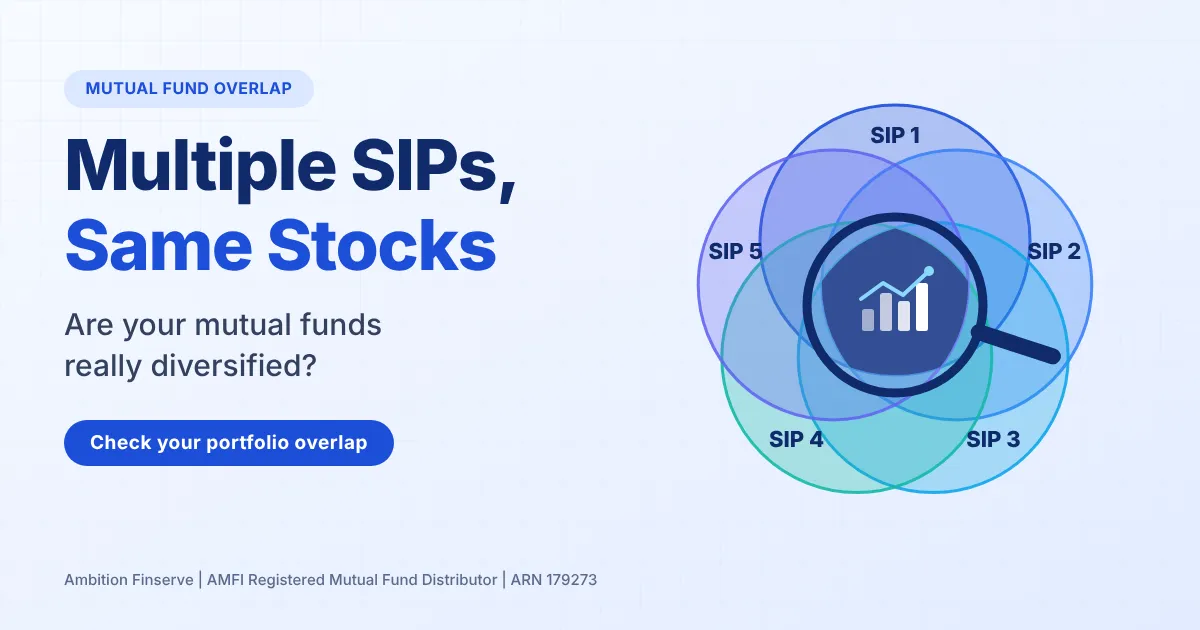
Many mutual fund investors believe that investing through 4 to 5 different SIPs (Systematic Investment Plans) automatically creates a well-diversified portfolio. The common belief is that spreading money across various fund houses (AMCs) or fund names shields you from market risk.
But does true financial diversification actually work this way? Let’s break down the hidden trap of mutual fund portfolio overlap.
1. What is Mutual Fund Overlap? (The Hidden Risk)
Mutual fund portfolio overlap occurs when different funds—despite having distinct names, categories, or fund managers—invest heavily in the exact same underlying company stocks.
- Example: You might hold one Large-Cap Fund and one Flexi-Cap Fund from two different fund houses.
- However, checking their underlying portfolios reveals that both hold heavy allocations in top blue-chip giants like Reliance Industries, HDFC Bank, and Infosys.
- The Result: Even though you are paying two separate expense ratios, your hard-earned money is effectively concentrated in the very same equities.
2. Why Portfolio Cluttering Hurts Your Returns
- False Sense of Security: Holding multiple redundant funds doesn’t reduce risk; it just multiplies administrative hassle and tracking costs.
- Higher Total Expense Ratio (TER): You pay separate management fees for essentially duplicate stock selections.
- Amplified Drawdowns: If top overlapping stocks correct sharply, all your funds suffer simultaneously, defeating the core goal of asset allocation.
3. Step-by-Step Guide: How to Check if Your Mutual Funds Are Diversified
To build a truly diversified mutual fund portfolio, follow these data-driven steps:
- Analyze Top 10 Stock Holdings: Download the monthly factsheets of all your mutual funds and list their top equity holdings.
- Identify Common Equities: Look for repetition. If a single stock spans across 3 or more of your funds, you are experiencing high portfolio concentration.
- Use Online Portfolio Overlap Tools: Utilize free financial tools to measure exact duplication percentages. Generally, if two funds share more than 40% to 50% stock overlap, holding both is redundant.
- Diversify Investment Styles: Instead of buying multiple large-cap funds, combine complementary categories like Mid-Cap, Small-Cap, and international or global funds with low correlations.Disclaimer: This blog is for educational purposes only and does not constitute investment advice or a recommendation to buy or sell any security. Please do your own research or consult a qualified advisor before investing.